
THE GOOD STUFF
where you can find our case studies, thought leadership pieces and other content
DO NOT DELETE - LEAVE AT THE TOP
Case Studies
Optical campaign – UK
Conducted a media audit upon winning a new client. Identified new digital & email vendors, and adopted “test & learn” to establish what worked. Campaign performance improved across all metrics, CTR, IR & display time all up, and delivering 1000s of clicks every month. Client thrilled with ROI and increase in SOV.
Haem/Onc campaign – Europe
Client wanted pre-launch teaser and then an impactful launch for a new niche drug. Full media mix of banners & bespoke emails introduced. The addition of PPC and LinkedIn ads drove 1000s of clicks per month. Client delighted with campaign and especially the ROI. Awarded us their next launch, without needing to pitch for it.
Pharmacy campaign – UK
Client wanted to create awareness of new offering, and drive clicks to site. Large format impactful banners ran on Pharmacy sites, which created genuine & increased noise & more awareness. Bespoke emails hugely successful in driving clicks to site, 100s per month. Compelling creative led to this campaign winning PM Society awards, client was ecstatic.
“Build it, and they won’t come” - podcast interview on the world of HCP paid media
A podcast where Dan Buckland of Brandcast Health interviews Steve on a whole range of subjects. As Dan puts it “In this episode, we’ve got an hour of pure insight from Steve Simmonds of SJS Health Media, a seasoned pharma paid-media consultant, to help you understand how to make the most of your media budget and get the engagement you deserve.”
“Don’t Buy For Me, Argentina” - thought leadership piece, on international v local media buying
An article which first appeared on the Solli website, original link here …
https://solli.global/solli-hub/dont-buy-for-me-argentina/
Full text reproduced with kind permission of Solli.
Don’t Buy For Me, Argentina
Why International Media Agencies Bring Added Value
Choosing the Right Media Planning Agency
One of the first questions a pharmaceutical company should ask when planning a paid media campaign is: Who should handle the media planning? Should it be the local affiliate’s media agency, or the international media buying agency/consultant, possibly based in London or Paris?
At first glance, opting for a local agency for a country-specific campaign seems logical. However, I argue that starting with an international agency or consultant is often the smarter move. Sometimes, a little distance brings much-needed perspective. Here’s why.
Campaign Types: Continental, Multi-Local & Local
For continental or international campaigns, pharmaceutical companies typically rely on their specialized media buying agencies, which handle large-scale campaigns using English-language creatives and pre-approved assets. These agencies offer cost efficiencies and scalability.
For multi-local campaigns—targeting a cluster of countries like Germany, Switzerland, and Austria, or an EU4/EU5 campaign (France, Germany, Italy, Spain, and the UK)—clients may engage agencies in specific regions. For strictly local campaigns (e.g., UK, Denmark, or Argentina), clients often default to a country-specific agency.
This article does not seek to undermine local agencies—their expertise and execution can be excellent. However, certain strategic advantages come with an international perspective that local agencies might lack.
Collaboration for Maximum Client Benefit
Local insights from the pharma affiliate or in-country agency are invaluable and should always be welcomed. However, these suggestions must be evaluated through a broader lens. The international agency or consultant can integrate local insights with additional opportunities, ensuring only the highest ROI options make the final plan. Think of it like a master chef curating a dish—some ingredients are local, while others, though sourced from afar, enhance the final result.
The Compliance Factor: A Shared Responsibility
A competent international media agency or consultant is well-versed in regulatory requirements across different markets. While local agencies possess deep knowledge of their country’s compliance landscape, the process is not exclusive to them. Collaboration with the local pharma affiliate remains essential for MLR (Medical, Legal, and Regulatory) review.
I’ve encountered cases where a local agency proposed a publication that was later deemed non-compliant upon closer inspection. When it comes to compliance, the more oversight, the better.
What International Agencies Know That Local Agencies May Not
- Leveraging Existing Media Buys
Pharmaceutical clients may already have large-scale media buys in place. The international media agency that negotiated these deals can strategically align new local campaigns with existing contracts, potentially unlocking purchasing power benefits, rate discounts, or added value. These efficiencies are of great interest to regional procurement teams.
- Access to Exclusive Media Buys
Some high-value media opportunities are only available at a continental or regional level. For instance:
Medscape’s Condition Article Exclusivity
G-Med’s Microsites & Conference Mini Communities
NEJM’s Specialty Packs (with some country flexibility)
These strategic placements, often referred to as “roadblock” advertising, can effectively eliminate competition and create multiple touchpoints with the target audience. Local agencies are unlikely to be aware of these opportunities, as they cannot be purchased at the country level.
- Digital Geo-Targeting for High-Impact Local Reach
An international agency may identify geo-targeted opportunities that a local agency might overlook. For example, targeting Spanish oncologists could involve:
Spain-only impressions in global oncology journals like Journal of Clinical Oncology, JAMA Oncology, Annals of Oncology, and The Lancet Oncology
Specialist publications such as OncoAssist
Local publications, e.g., the SEOM (Spanish Society of Medical Oncology) journal
Geo-targeting within international titles can be highly cost-effective, allowing for significant Share of Voice (SOV) at a country level while complementing local publication efforts. This becomes even more critical for sub-specialties, such as breast or kidney cancer specialists within a specific geography.
- Expertise in Programmatic Buying
Programmatic buying offers another layer of targeting that an international agency is more likely to maximize. Providers like The Digital Peloton and Doceree can target individual countries or clusters, ensuring compliance while expanding reach.
- Bespoke Email Targeting
Certain international providers specialize in high-quality HCP (Healthcare Professional) email databases at both global and country levels. Vendors such as IMI, Medscape, Sermo, and G-Med can be evaluated based on:
ROI and performance metrics
Coverage of HCPs in the target country
Purchasing power efficiencies
Bespoke email campaigns are particularly useful when a client requires direct traffic to a site or needs to deliver complex messaging that benefits from long-form content.
The Bottom Line: Space is Space
At the end of the day, media agencies and consultants secure the best available media space in line with the client’s brief and target audience. Whether the campaign is managed internationally or locally should not matter – what counts is compliance and delivering the right messaging in the most effective channels.
So long as locally approved and compliant creative assets are provided, the medium remains the same: space is space – it’s what you do with it that matters.
Final Thoughts
While local agencies offer deep market knowledge, international agencies provide a broader strategic perspective, greater purchasing power, and access to exclusive media opportunities. A collaborative approach ensures the best of both worlds, delivering a compliant, high-impact campaign with maximum efficiency and ROI.
Steve Simmonds is the Founder and Director of SJS Health Consulting Ltd. He has over 20 years of experience in pharmaceutical media, both publisher and agency side. His company provides paid media strategy and planning within the healthcare vertical, on a global basis
“Relic or Renaissance?" - thought leadership piece, on Reprints
“Relic or Renaissance? The Potential Value of Journal Article Reprints” – an article which first appeared on the Solli website, original link here …
https://solli.global/solli-hub/relic-or-renaissance-the-potential-value-of-journal-article-reprints/
Full text reproduced with kind permission of Solli.
Relic or Renaissance? The Potential Value of Journal Article Reprints
Can e-prints / reprints find new relevance in today’s digital age?
In the fast-evolving world of pharmaceutical marketing, where digital innovations and new technologies often steal the spotlight, journal article reprints might seem like a relic of the past. However, these seemingly old-fashioned tools hold immense potential to connect with healthcare professionals (HCPs) on a deeper level.
For many pharmaceutical companies, reprints are an underused gem. But why? Why aren’t all companies leveraging every tool available to them? The answer is clear—they should be. Let’s explore why reprints deserve a prominent place in your marketing strategy, even amidst the latest technological advancements.
The Basics: What Are Reprints?
Journal article reprints are bulk reproductions of articles previously published in academic journals. For pharma companies, these reprints serve as a powerful way to promote new products and disseminate important information. Recognized by HCPs as credible and valuable, these reprints often come with a journal-branded cover, with optional disclaimers and logos for added context.
Reprints vs. ePrints: A Matter of Medium
Think of reprints as the traditional, tangible method—physical copies of articles that HCPs can hold and read. Despite growing environmental concerns, many in the pharma industry still prefer paper reprints. On the other hand, ePrints offer the same valuable content in a digital format, adding layers of functionality and convenience for the modern user.
Practical Applications: Bringing Reprints to Life
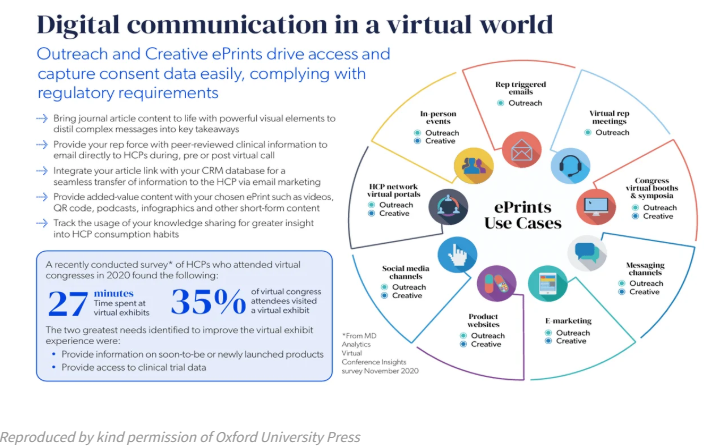
Reprints and ePrints are versatile tools that can enhance various aspects of pharma marketing:
- Rep Visits & Follow-ups: Enhance face-to-face interactions and e-detailing with valuable content.
- Email Campaigns: Embed links and integrate with platforms like Veeva for a seamless user experience.
- Conferences: Showcase both paper reprints and ePrints at booths to engage attendees.
- Brand Websites: Host papers to attract HCPs with high-quality, valuable content.
- Banner Ads: Offer ePrints as exit options for HCPs to access full articles.
- Translations: Make content accessible and relevant at the local level.
Nadia Gurney-Randall, Reprints Consultant at NGR Healthcare Reprints Limited, underscores this versatility: “My pharma clients buy paper and digital reprints because it is an effective and independent means of delivering the original peer-reviewed paper to their target market. HCPs want to see the evidence base for themselves.”
The Evolution of Giveaways
Remember the days when pharma congresses handed out pens, teddy bears, and other trinkets? Today, stringent “transfer of value” clauses mean that all giveaways must be recorded and compliant. This leaves reprints and ePrints as some of the few compliant, valuable giveaways that pharma reps can provide, ensuring they remain an integral part of your marketing strategy. Though “transfer of value” does already apply to ePrints in some countries, such as USA and France.
Trust and Value: The HCP Perspective
HCPs have made it clear—they trust peer-reviewed journal articles significantly more than pharma-produced content. The statistics back this up:
Peer-reviewed journal articles are the most trusted source for staying up to date with medical information (Wiley 2021 HCP engagement survey, global. n=1,016).
80% of HCPs mistrust pharma’s digital content, with data cherry-picking being a top concern.
Medical journals are considered useful by 80% of HCPs, compared to 34% for pharma mailings (HDMS Hospital Doctor Media Survey, July 2023).
89% of HCPs would likely or very likely change their prescribing habits based on published content in its original form (NEJM survey of 617 US-based HCPs, February 2023).
Richard Young, Reprints Sales Manager at Oxford University Press, emphasizes the importance of credibility: “Article reprints and ePrints are a tried and tested solution, valued by HCPs globally. In an industry where compliance is paramount, the independence and credibility of rigorously peer-reviewed content are more important than ever.”
Navigating Licenses and Open Access
The use and commercial reuse of reprints depend on the original paper’s license. While there’s been a shift towards Open Access, many pharma-sponsored articles are still under restrictive licenses (CC-BY-NC or CC-BY-NC-ND). These require reprints to be ordered directly from the publisher, or via intermediary agencies, ensuring compliance and proper use.
The Prestige of Journals: A Mark of Excellence
Papers on safety and efficacy are crucial for drug approval, making them highly valuable to HCPs. Prestigious journals, often affiliated with learned societies, add credibility to these papers. Acceptance rates for top journals like The Lancet and NEJM are around 5%, underscoring the importance and novelty of the published research. Having reprints from these high-impact journals is especially valuable.
Clinical Practice Guidelines: The Gold Standard
Clinical Practice Guidelines, often published by society titles, serve as the “comprehensive guide” for treating specific conditions. When a pharma product is mentioned in these guidelines, reprints become even more valuable, offering a trusted source that HCPs regularly consult.
Conclusion: A Call to Action
Jan van den Burg, CEO of Tangent90, highlights the engagement potential of ePrints: “ePrints are among the most trusted forms of content. A recent NEJM study shows that 89% of HCPs would likely or very likely change their prescribing habits based on published content in its original form. This is a great opportunity for pharma companies to enhance HCP engagement.”
While reprints might seem like a relic of the past in the age of digital innovation, they hold great value among the new technology. The versatility and credibility of reprints make them a powerful tool in pharma marketing.
Steve Simmonds is the Founder and Director of SJS Health Consulting Ltd. He has over 20 years of experience in pharmaceutical media, both publisher and agency side. His company provides paid media strategy and planning within the healthcare vertical, on a global basis. Sometimes this may include Reprints.
“Zoom” - some fun, the song Zoom with lyrics updated for remote working
Just a bit of fun here, Steve re-worked the song Zoom, by Fat Larry’s Band, updating the lyrics for the post-COVID world of remote working.
“Steve is a brilliantly experienced pharma media professional, with an enviable breadth of knowledge from both publisher and agency settings.”
Richard Springham, Founder & CEO, solli & Skittle Media
Get in touch
Or, you can complete this short form to send us a message
We’re based in Surrey/SW London. Happy to meet in person at any convenient location, though you may prefer an initial Teams/Zoom discussion first.